The Data Center Backlash Doesn't Have a Party
In eleven months, data centers went from almost unmentioned on the radio to one episode in ten. We read 1,300 of those broadcasts to see what they're saying.
Catchwind transcribes every episode of several hundred news and politics programs every day: NPR affiliates, local talk radio across 140 markets, political podcasts, and the national shows. Between September 2025 and July 2026 that came to 89,329 episodes we transcribed and extracted insights from. Here is what happened to data centers inside them.
From niche to everywhere
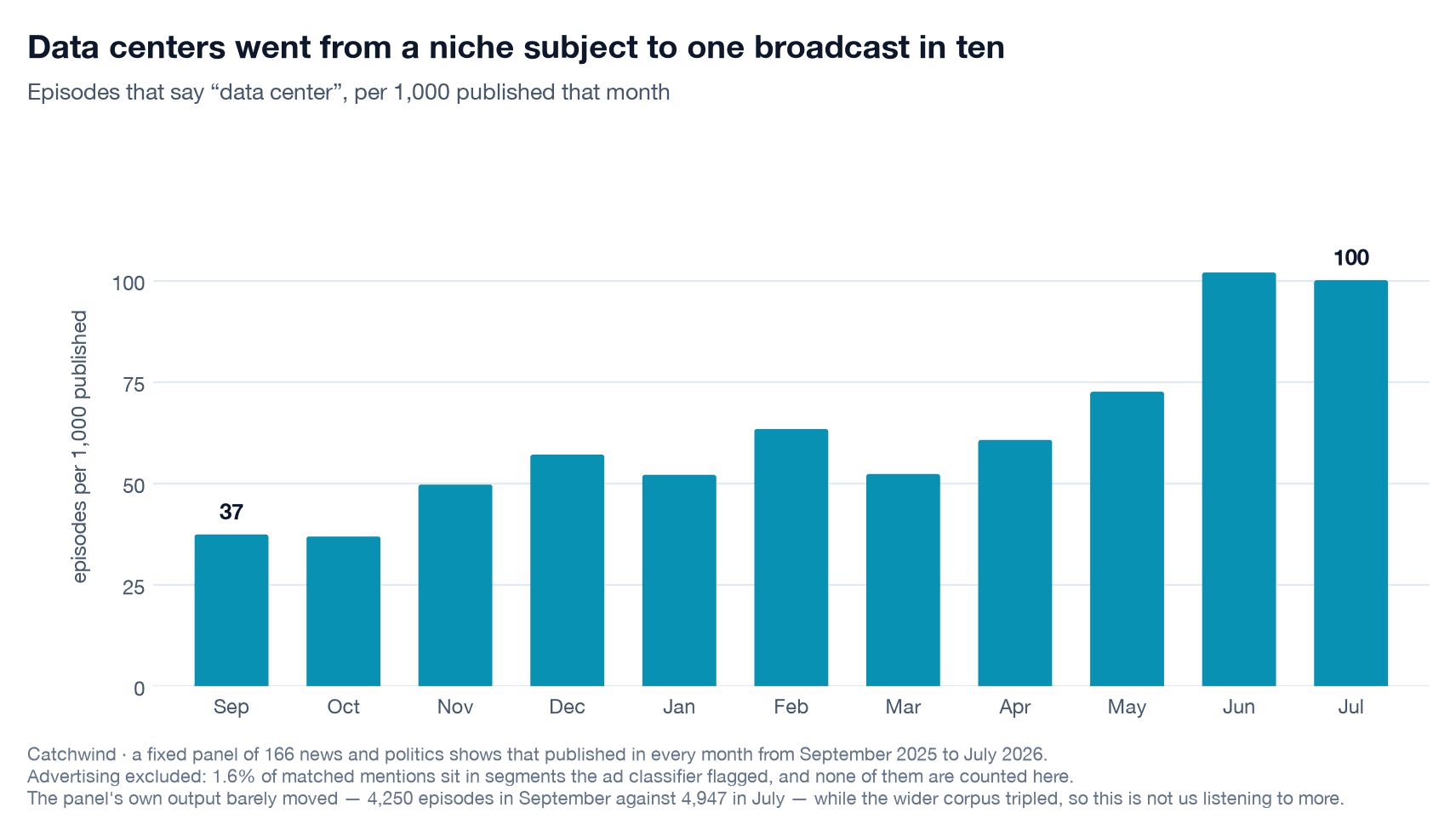
Let's start with the basics: pure volume. That is, how often are data centers being discussed. Generally rather than looking at raw mentions we will look at some sort of rate normalized by the number of episodes so we don't see a spike just because we had more episodes. In September 2025, 37 of every 1,000 episodes said "data center." By July 2026 it was 100 — one broadcast in ten. That itself is pretty wild: about 10% of our audio recordings, across ~90K episodes are mentioning data centers.
Local vs. National Broadcasts
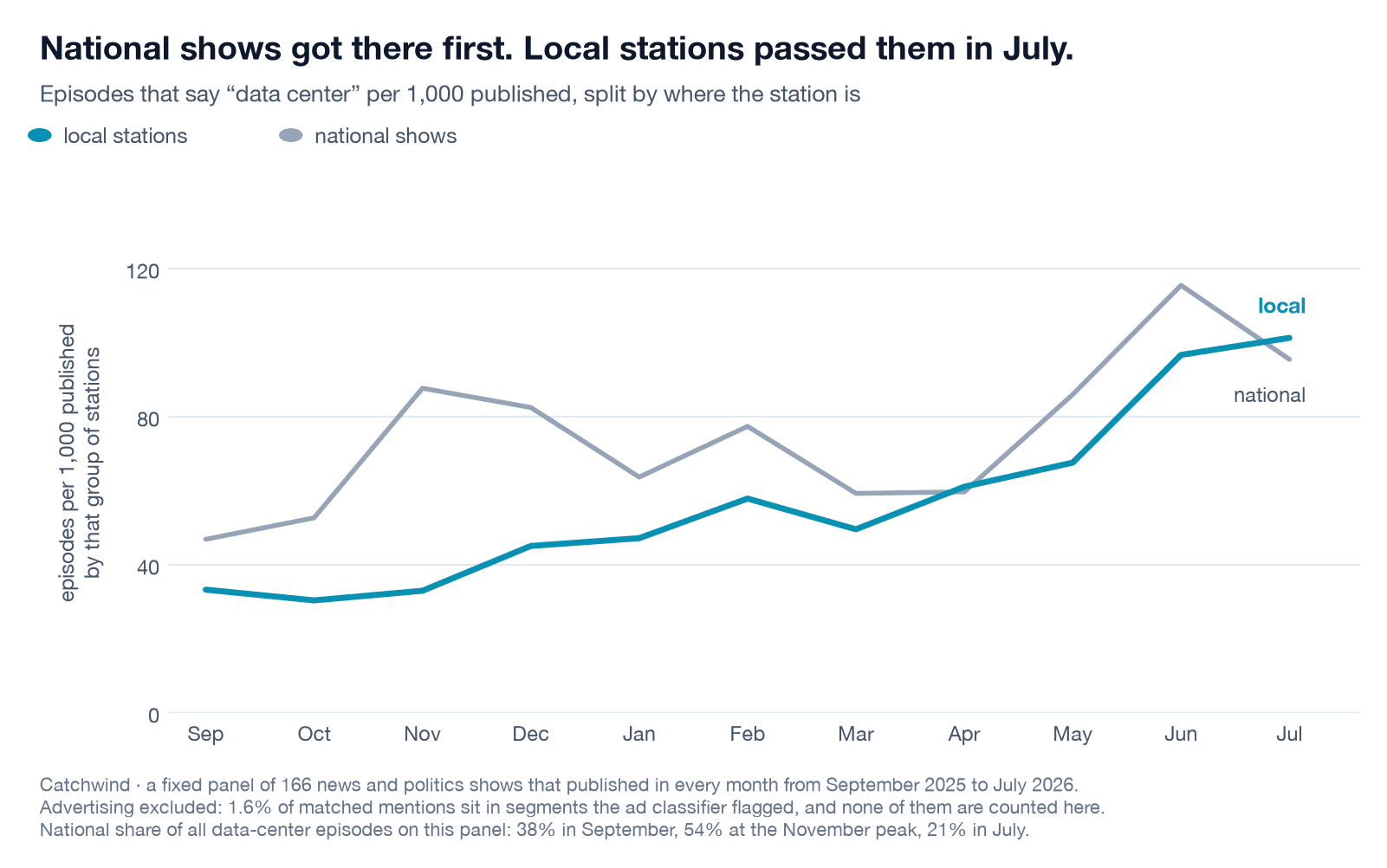
National programs (Ben Shapiro, Brian Kilmeade) started talking about it first, typically linked to the AI revolution in general. Back in November 2025 we already saw nearly 9% of national recordings we mentioning data centers. What is interesting is at the time it was pretty quiet on local: less than half of the national frequency. However, over time as the public has soured on AI, and the impact of data centers has become more clear, we see local stations picking up the story. In fact, July was the first month we saw data centers as a topic more frequently in local recordings than national.
However, they are not covering the same subject. On national programs, 80% talk about data centers as AI infrastructure — the buildout, the capex, Nvidia and OpenAI. On local stations, only 31% do. Local stations are more focused on covering a specific project: a rezoning, a public hearing, a county commission vote. As an example, here in Nashville there is a huge controversy around trying to put a data center near the Nashville zoo. We see tons of local coverage (the 400,000-signature petition and the council's 26–1 vote, an interview with the councilman writing the rules) on this topic.
The argument is about your power bill
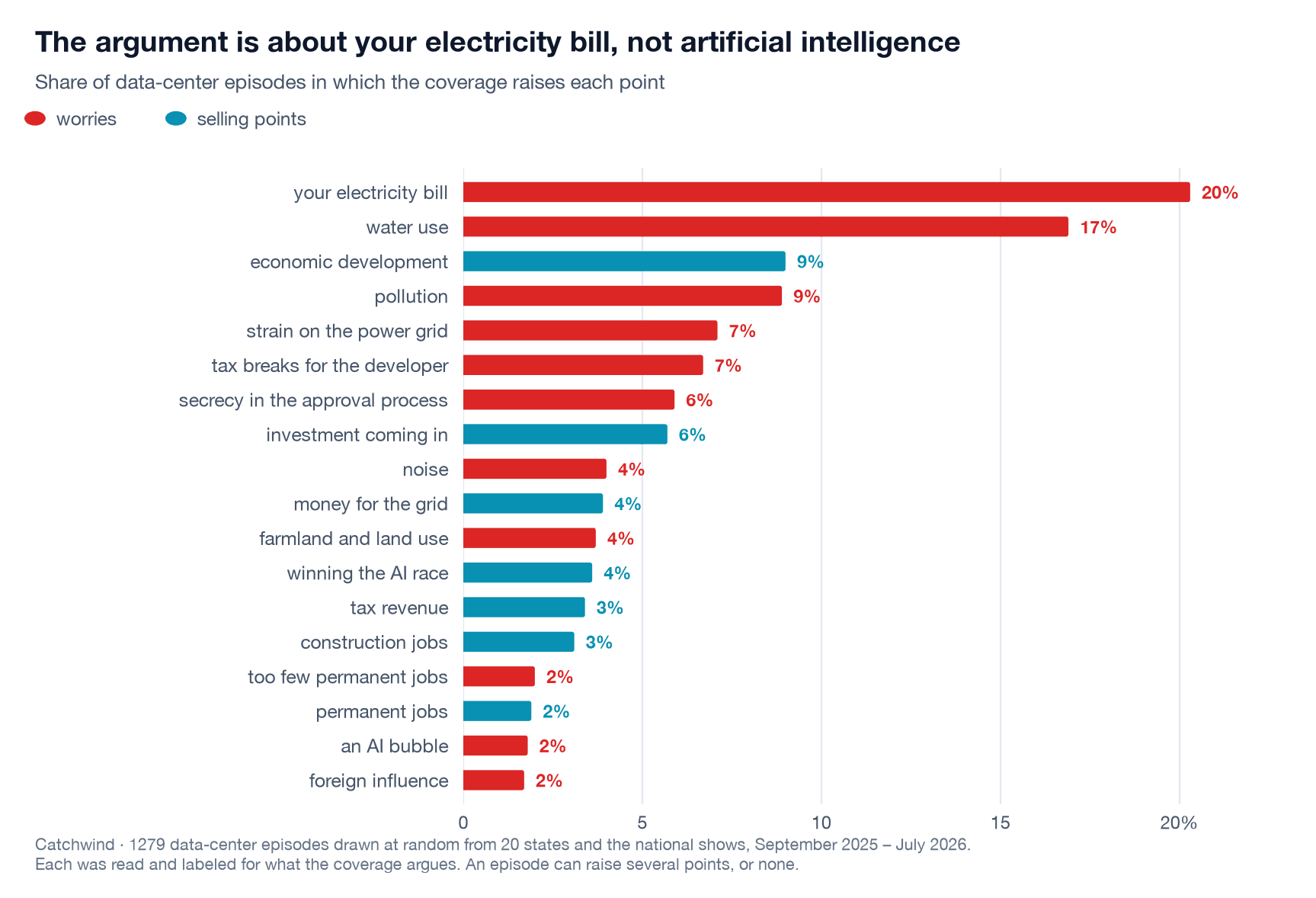
Across the 1,300 episodes we analyzed, 54% raise at least one worry about data centers and 23% raise at least one point in their favor. The single most common argument in American political audio about data centers is that they will raise your electricity bill — it comes up in one episode in five. Water use is next, in one in six. Artificial intelligence, the thing the buildout is actually for, barely features in the argument at all. The case for is thinner than the industry's own pitch would suggest. Economic development appears in 9% of episodes, investment in 6%, tax revenue in 3%. Permanent jobs — the promise these projects are usually sold on locally — appears in 1.9%.
Here is Erick Erickson, a conservative host in Atlanta (10 September 2025, 11:37): "Your power rates are going up because power companies don't want to just jack up the rates on the data centers... so your rates are going up so that the data centers don't have to pay the full price of their power."
The negative sentiment is everywhere
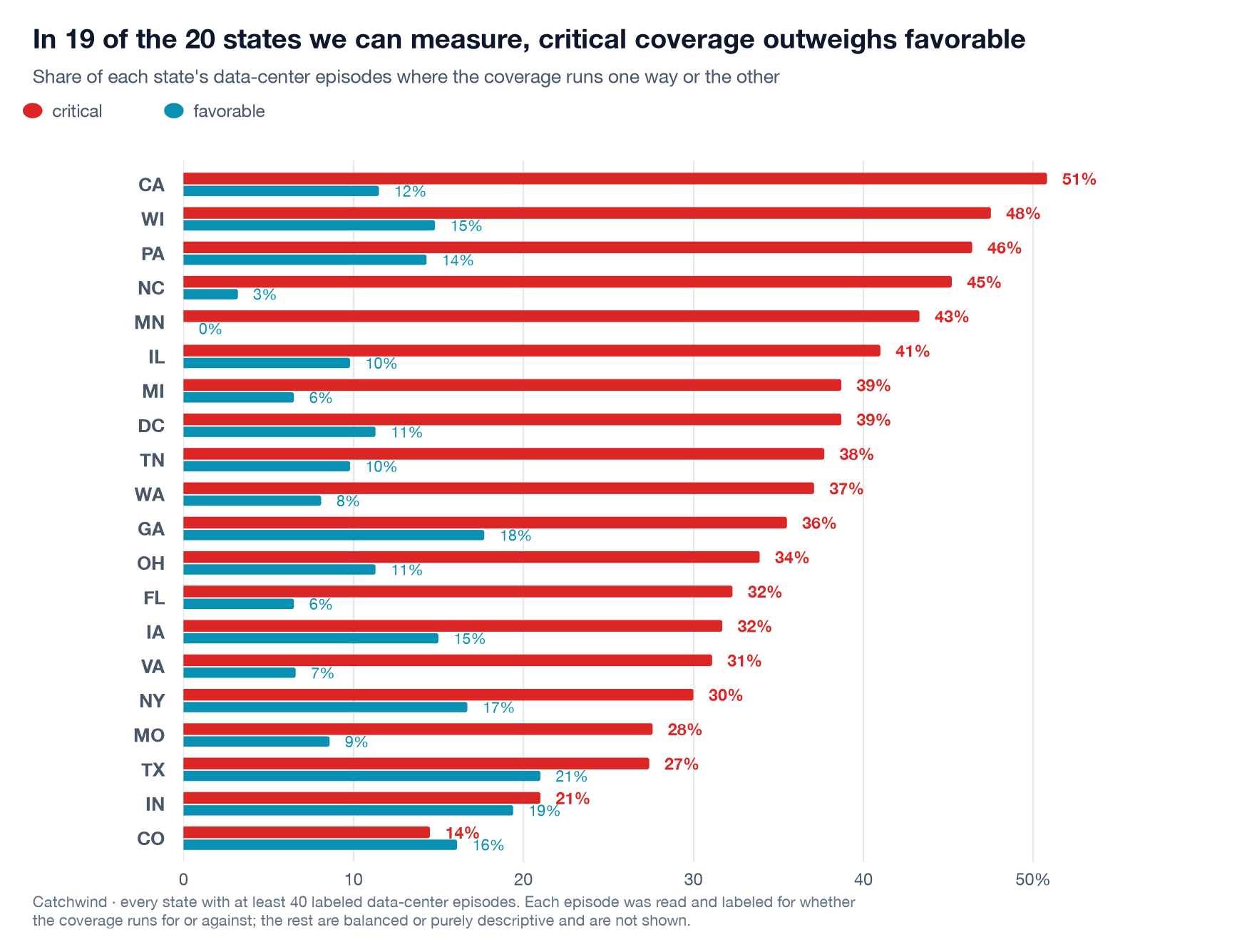
The pattern barely moves by state. Critical coverage outnumbers favorable coverage in 19 of the 20 states we can measure, usually by three or four to one. California, Wisconsin, Pennsylvania and North Carolina run hardest against. Colorado is the only state where favorable coverage leads, and only just. It should also be noted most of Colorado audio source are mixed at best, but one episode did a deep dive into the importance of data centers for the digital economy that swayed it positive.
It also did not drift this way. In the first five months of the window 32% of episodes ran critical; in the last six, 35%. Data center coverage did not turn negative over the year — it started negative and got louder with more places talking about it.
The fight is inside both parties
On the substance — bills, water, land, process — coverage on left-leaning and right-leaning national shows is close to indistinguishable. What the transcripts show instead is both parties splitting internally, in public, market by market. That is, it's not really consistent along party lines like virtually every issue in America.
North Carolina. Governor Josh Stein, a Democrat, vetoed a bill that would let utilities bill customers in advance for plants built to serve data centers. Republicans and a handful of Democrats overrode him. It is now law. Stein and Attorney General Jeff Jackson then went after Duke Energy's rate request, which one WRAL newscast pegged at up to $30 a month on household bills by 2028.
Missouri. Senator Josh Hawley spent the autumn hammering data centers over what ratepayers will be charged — and got a letter of correction from Cindy O'Loughlin, a Republican state senator, defending the bill her chamber passed. A local host described it plainly: "He's picketing with union guys at one hand, and then he's saying that citizens are going to be overbilled for all of the buildout of the big data centers."
Texas. Greg Abbott spent years courting the industry. By July 2026 he was calling for a ban on new data centers in rural Texas, after what one Houston host described as "a growing backlash from the rural Texans they have long counted on as their strongest supporters." Agriculture Commissioner Sid Miller wants a statewide moratorium. The state Republican convention pushed for local control over zoning — a conservative party asking for more land-use regulation, not less.
New York. Kathy Hochul ordered the country's first statewide pause on large new data centers. President Trump called it a terrible decision. So, quietly, did the labor unions who expected the construction work — leaving a Democratic governor squeezed from both directions at once.
Indianapolis. A city-county councilor put it best on WIBC, describing a joint Republican-Democratic vote against a proposed Google facility near Franklin Township: "It's wild when you guys can all come together. Like on this one subject, there's no difference between you and Jesse Brown, councilor."
When it reaches an actual vote, it isn't close. Sixty-five episodes describe a council or board voting unanimously — LaGrange, Georgia; Saline, Michigan; Madison, Wisconsin; Apex, North Carolina. Of the votes where a split tally was read out on air, the tightest we found was 5–2. And it runs both ways: DeForest, Wisconsin killed a $12 billion project 7–0, while Vance County, North Carolina approved a rezoning 6–1 in front of a packed house. These bodies are not dividing along party lines.
The industry is buying ads on the shows turning against it
One thing we found interesting is that you see data centers, or companies hoping to leverage the work, advertising. About 1.6% of the data center mentions we found are advertising. Graybar, which supplies electrical equipment to data centers, has been running spots on conservative and local talk radio in Pittsburgh, Philadelphia, St. Louis and New York: "The pressure on data centers has never been greater... Yep, Graybar does that." The industry and its allies are advertising into an audience that is, by our count, already three-to-one against them.
Three things worth taking
Track this locally or you will miss it. The national story peaked nine months ago. The growth since then is entirely in county commissions and city councils.
Do not assume it splits on party. It splits governors from their own legislatures, senators from their own state parties, and Democratic governors from their own building trades.
The strongest argument against is the utility bill, and it has no natural partisan owner. Whoever claims it first gets a coalition that does not otherwise exist.
Methodology
Every transcribed episode published 1 September 2025 – 31 July 2026: 89,329 episodes, 187 shows in the first month rising to 415 in the last, across 140 markets. The match is a regular expression for "data center" and its variants over stored transcript text.
Time series run on the 166 shows that published in every month of the window. The 1,300 labeled episodes are a random sample across 20 states and the national shows, capped at 62 per state so a big state cannot swamp a small one; 1,279 are editorial and 21 are advertising. Each was read and labeled for stance, arguments, actors and whether it was an ad — by a model reading the transcript, not by matching words against a list. "Critical" here means an argument was made against them, not that a keyword appeared.
To check the labels are stable, a second labeler re-read 120 of the episodes blind, without seeing the first pass. The two agreed on the critical-or-not call 93% of the time, on the four-way stance 89%, and on whether an episode was advertising 100%.
Two limits. Coverage is not opinion: a state where the coverage runs critical is a state where critical coverage is being broadcast, not one where most people object. And we track no county commissioners or township boards — the bodies actually approving these sites — so we can describe their votes only when a broadcast said so.
Catchwind is a political news intelligence platform built on deep local news audio — 300+ stations across 135 markets, transcribed every day. If you want this breakdown for your own state or market, get in touch.