Mamdani is now the 3rd most-discussed politician in America.
Over the past year, no Democrat's name was spoken more often on American podcasts, radio and news. He is the talking point of the party, whether they like it or not.
Mamdani’s Meteoric Rise
Let’s first outline the data we are talking about. Catchwind.ai listens to the radio, news recordings and more to bring unique political insights at both the local and national level. Every day we download and transcribe every new episode from hundreds of American news and politics programs — NPR affiliates, local morning drive, commercial talk radio, national podcasts — and then search those transcripts for the names of about 430 political figures we track. You can see all the shows we track here. We continue to add more sources weekly. TLDR: we have a lot of audio data we have turned into insights.
This gives us a pretty unique dataset: literally millions of minutes of political dialogue captured from September 2025 through today (August 2026). In total that came to 80,904 episodes. This article is what that volume of episodes says about one politician, who has become the voice of the Democratic Party, whether they like it or not: Zohran Mamdani.
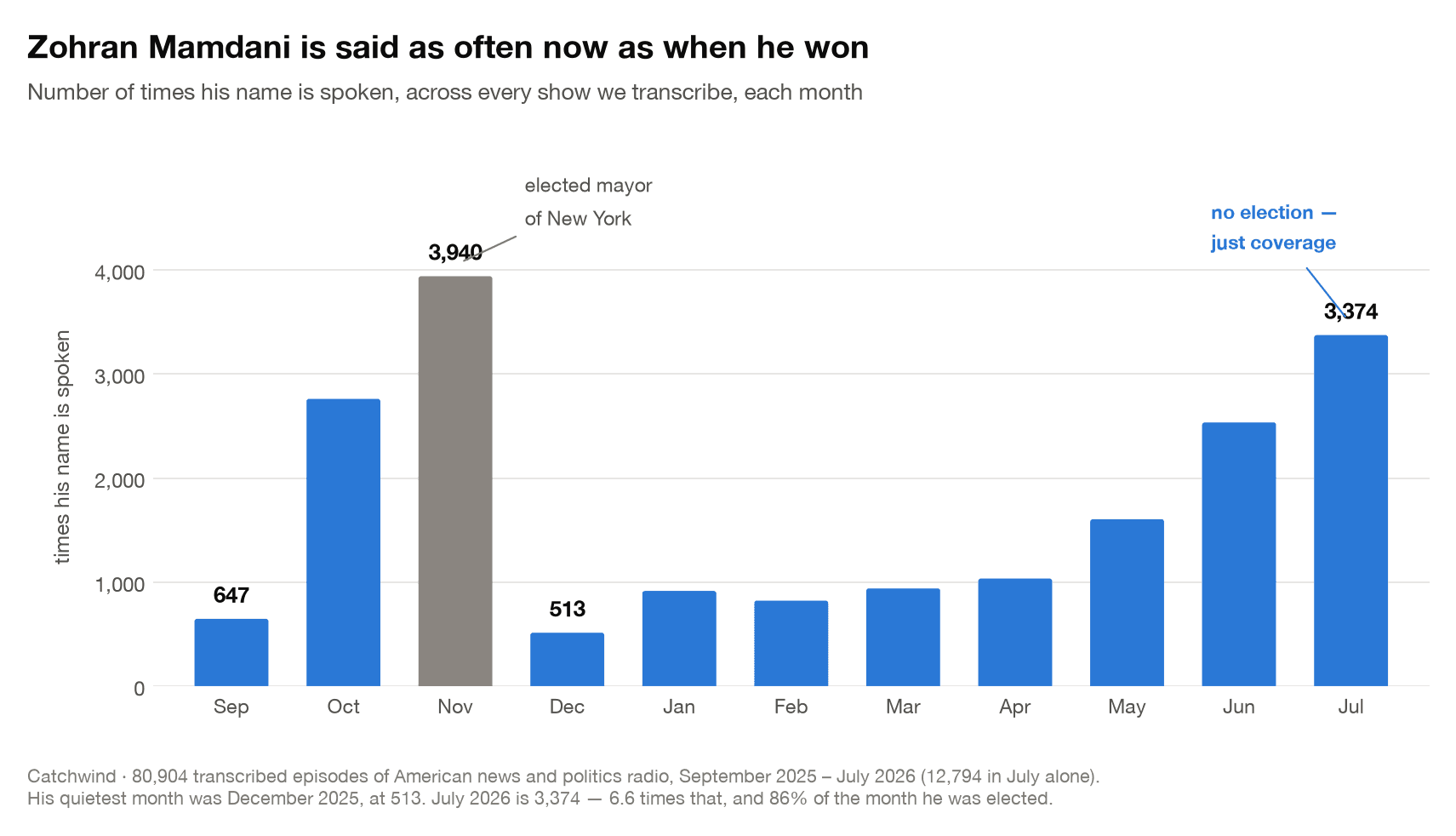
Everyone knows Mamdani has had a meteoric rise, but even we were surprised by just how much he is being discussed.
Unsurprisingly, mentions peaked around his November mayoral victory, but what is surprising is that we are now nearly back to that level. In fact, our data shows that Mamdani is the third most-discussed politician in America, behind only the president and vice president.
That is worth thinking about. Very few people knew who Mamdani was a year ago. Now, he is the most-discussed Democrat in America — more than Gavin Newsom, more than Kamala Harris, and more than any other 2028 hopeful. And unlike most claims about political attention, we have the data to prove it.
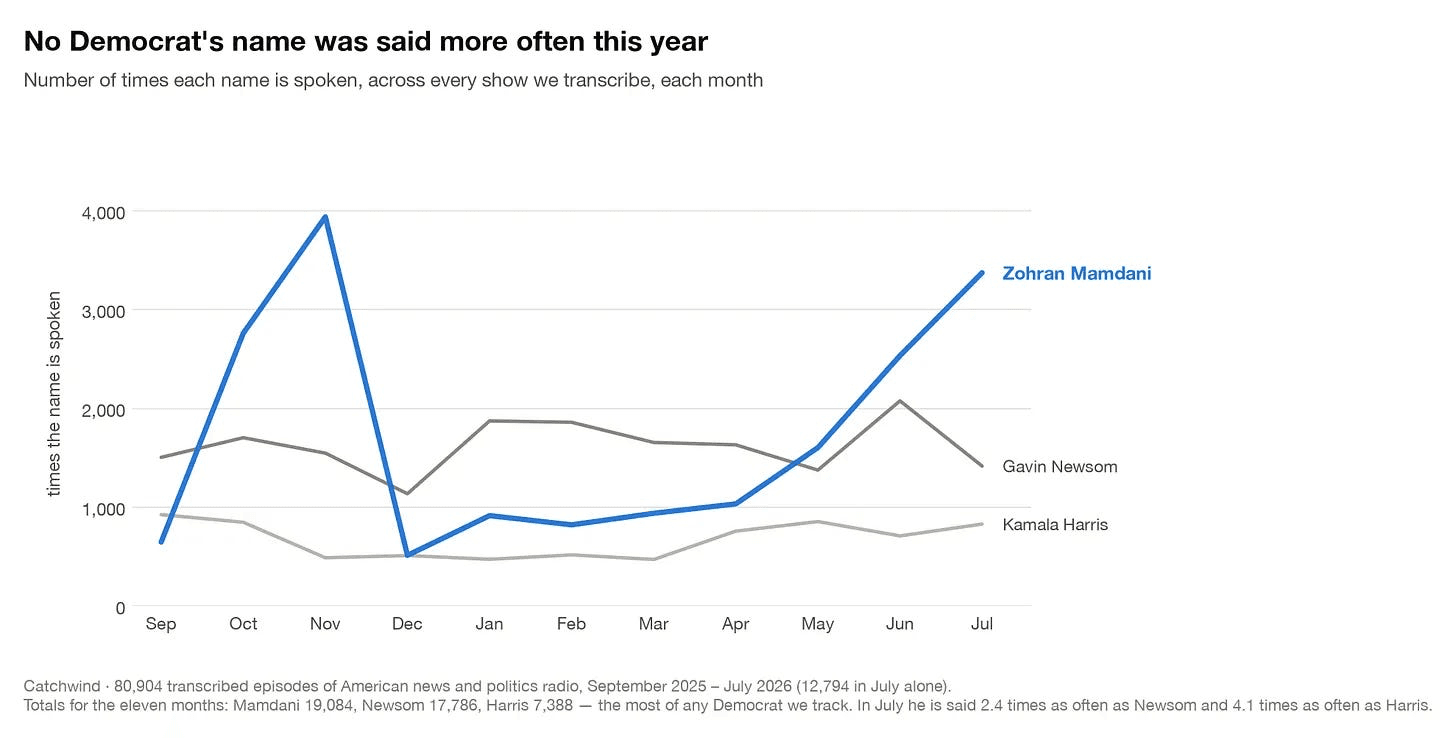
Across the eleven months, these are the Democrats whose names were spoken most on American radio:
- Zohran Mamdani — 19,084
- Gavin Newsom — 17,786
- Graham Platner — 15,052
- Chuck Schumer — 9,602
- Kamala Harris — 7,388
A mayor outranks the governor of California, the leader of the Senate Democrats, and the party’s last presidential nominee. The only person close to him is Newsom. And the only reason Graham Platner appears on the list at all is because of (1) the controversies surrounding him and (2) Maine holding the most-covered Senate primary in the country. He is a one-race phenomenon.
Newsom makes for an interesting comparison because his numbers are so steady. Every month of the year, he lands between 1,137 and 2,077 mentions. He is a fixed feature of the conversation, whether you like it or not — always there, never moving consequentially in either direction.
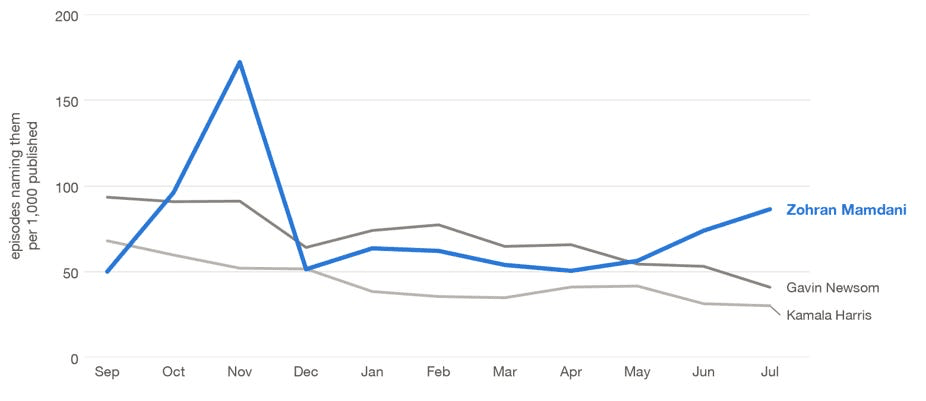
Mamdani is a rocket ship. In July, he was named 2.4 times as often as Newsom and 4.1 times as often as Harris. And if we normalize the chart by the number of episodes each month, we see that Gavin Newsom and Kamala Harris are actually being discussed less over time. That is, if we look at how often per episode folks are mentioned we see Mamdani rising and the others falling.
Local vs. National Chatter
One may be tempted to think that because he is the mayor of the largest city in America, naturally he will garner attention. Eric Adams certainly had his share of attention, typically for the wrong reasons. However, our data shows Mamdani is a national talking point.
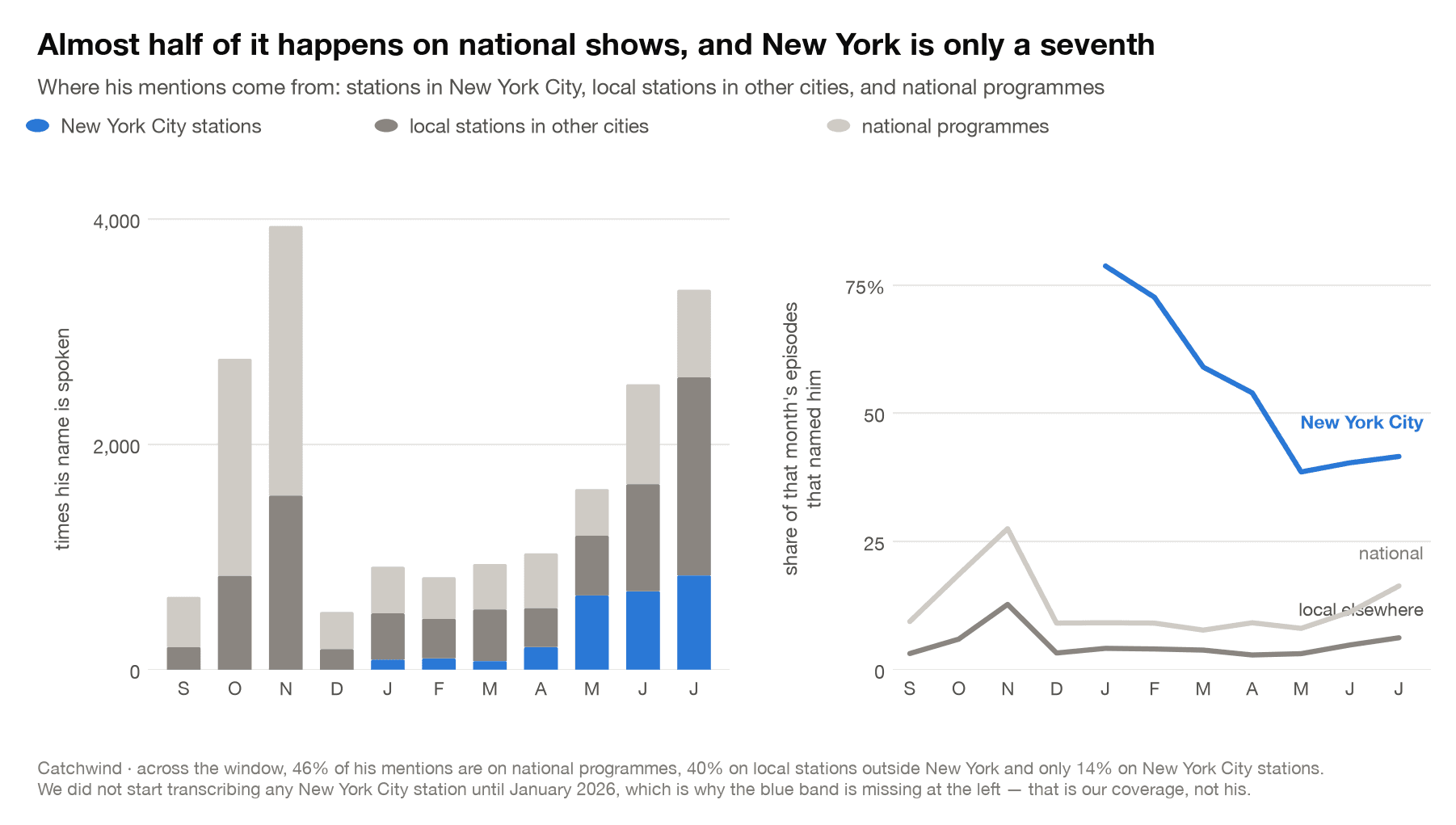
We split every station three ways: stations in New York City; local stations in other cities (WPHT in Philadelphia, WRKO in Boston, KFYI in Phoenix, WIBC in Indianapolis); and national programs that broadcast everywhere (think NPR, Ben Shapiro, etc.).
Forty-six percent of his mentions are on national programs. Forty percent are on local stations in cities other than New York. Only fourteen percent are on New York City stations.
That last number is pretty surprising. He is the mayor of one city, yet six out of every seven times his name is said on the radio, it is said somewhere with no stake in who runs New York. It is particularly interesting that so much of it is other local shows, and not just traditional large national right-wing shows.
And New York is not where his growth is coming from. From April to July, mentions on local stations outside New York jumped from 345 to 1,759 — a five-fold increase. National programs rose from 486 to 778. Whether it is his own politics or the rise of Democratic Socialists — Mamdani is at the center of the conversation.
The Right’s Obsession
We tag shows as conservative, liberal or straight news, using public media-bias ratings. Across the eleven months, on everything outside New York:
- Conservative talk shows published 12,727 episodes and said his name 9,076 times — 713 times per 1,000 episodes.
- Liberal talk shows published 3,254 episodes and said his name 1,538 times — 473 per 1,000. Note this is also something we typically see: liberal shows simply publish way less frequently than the right.
- Newsrooms (NPR, etc.) published 63,322 episodes and said his name 5,802 times — 92 per 1,000.
So a conservative talk show says his name roughly eight times as often as a newsroom does, per episode it puts out. In July that gap was at its widest all year: 878 mentions per 1,000 episodes against 100. Put the other way around: conservative shows produce 16% of the episodes we transcribe outside New York, and account for 55% of everything said about him.
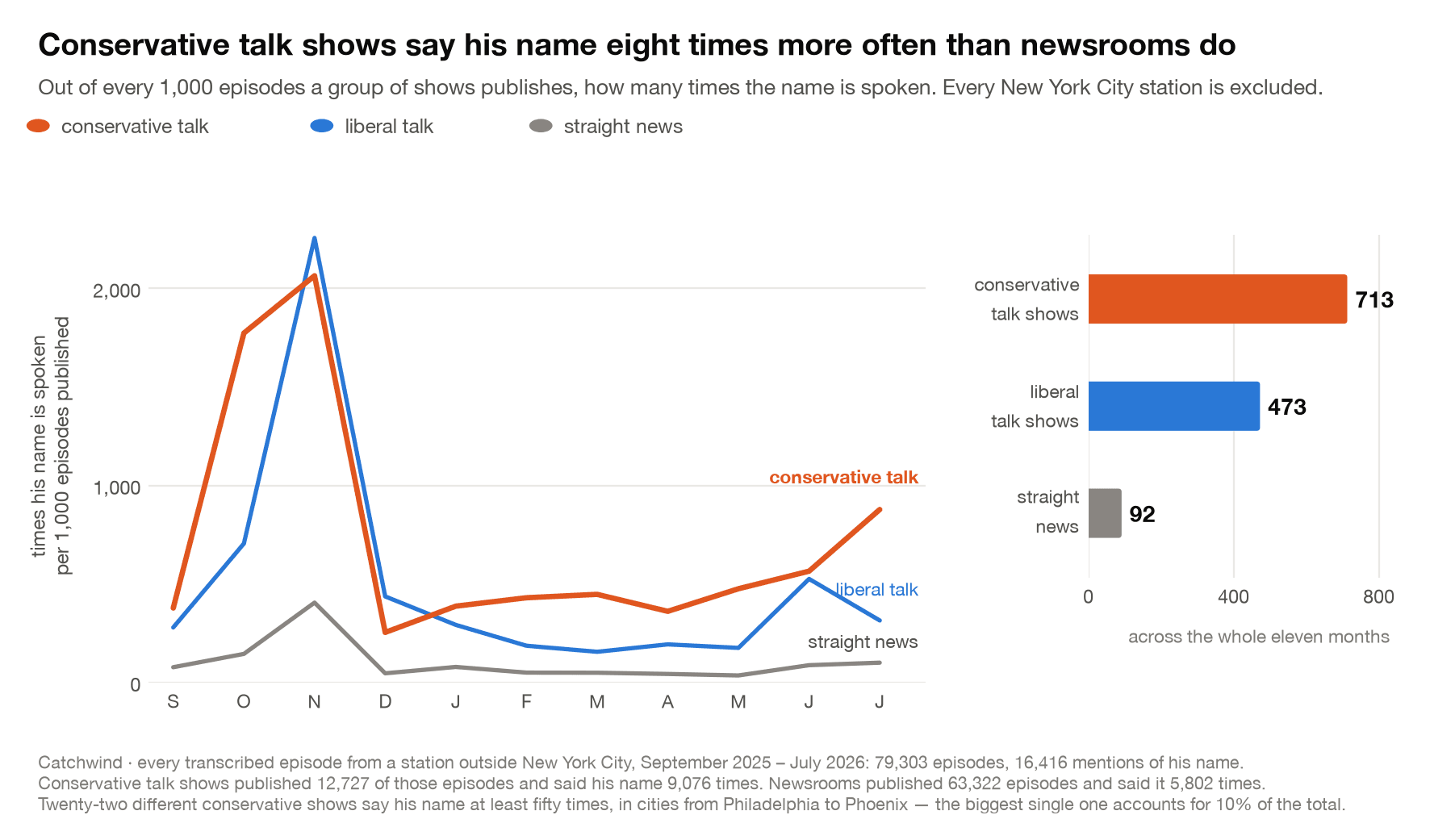
It is not one loudmouth. Twenty-two different conservative programs outside New York say his name at least fifty times, spread across the country — Dom Giordano in Philadelphia, Howie Carr and the Kuhner Report in Boston, Chris Plante in Washington, the Conservative Circus in Phoenix, Tony Katz in Indianapolis — alongside national shows like Clay Travis and Buck Sexton, Mark Levin, Brian Kilmeade, Ben Shapiro, and Guy Benson.
The biggest single program, Clay Travis and Buck Sexton, accounts for just 10% of conservative-talk mentions of him. The other 90% is spread across everyone else.
Liberal talk shows do talk about him more than newsrooms do, at 473 mentions per 1,000 episodes. But there is far less liberal talk radio: for every time his name is said on a liberal show outside New York, it is said six times on a conservative one.
Bottom line: Mamdani is a talking point in talk radio, but much less so in actual news reporting.
Mamdani and the Democratic Party
To say Democrats have kept Mamdani at arm’s length would be generous. Democratic leaders can decline to elevate a democratic socialist mayor; they cannot stop him from becoming the party’s most-discussed name, because the people doing most of the talking aren’t Democrats. Fifty-five percent of everything said about him outside New York happens on conservative talk radio — meaning his national profile is being built every day by the people most motivated to make him the face of the party. Whether they like it or not, he is being used to represent the party at the national level. And it is genuinely national: 86% of his mentions come from outside New York City, in markets where listeners have no direct exposure to anything he has actually done in office.
The practical consequence is that the party’s internal argument over whether to embrace his politics is being conducted at a fraction of the volume of the external argument over what his politics mean. And the second argument is the one reaching voters in Phoenix, Indianapolis, and Charlotte.
A strategy of quiet distance doesn’t lower his salience. It just cedes the description of him to the opposition.
Final Points
His coverage is largely produced by his opponents. More than half of everything said about him outside New York happens on shows that oppose him. If you want to know whether a politician has “broken through,” this is a case where the breakthrough happened in hostile media first.
He got here in nine months, and he is not an elected national figure. Newsom has been governor of the largest state for seven years and has been mentioned 17,786 times this year on a line that barely moves. Mamdani has run one city since January and passed him. Whatever the party’s 2028 conversation turns out to be, the name in it right now belongs to someone with no federal office and no national campaign.
Check out Catchwind.ai for more political insights, available for free.
If you enjoyed this piece please subscribe to our regular newsletter!
About The Data
WHAT WE TRANSCRIBED
Every episode published between 1 September 2025 and 31 July 2026 by the news and politics programs in our catalog: 80,904 episodes, from hundreds of shows. You can see all the shows we track here.
TWO WAYS OF COUNTING, BOTH SHOWN
“Mentions” counts every single time the name appears in a transcript. “Episodes naming him” counts each episode once, however many times it says the name. They answer different questions — how much is said, versus how widely it is said — and we give both, because our corpus grew so much that raw counts and rates tell different stories.
HOW WE FIND THE NAME
A machine-learning model reads each transcript and picks out people’s names; we then match those against our tracked list. It is not a plain word search, and for this subject that matters more than usual: of roughly 19,000 mentions, only 226 are the correctly spelled string “Zohran Mamdani.” Speech recognition mangles it constantly — “Mamdani” 7,160 times, “Zoran Mamdani” 2,384, “Mondami” 1,307, “Mondani” 1,301, “Mandami” 777, and a long tail beyond that — and we fold those variants together. We checked six randomly chosen July episodes by hand: all six were genuinely about him, and two contained no correctly spelled instance of his name anywhere. Any residual error in this count runs upward, not downward.
WHAT “CONSERVATIVE”, “LIBERAL” AND “STRAIGHT NEWS” MEAN HERE
We hand-label a show’s leaning from published media-bias ratings, and only for national opinion and talk programs plus a handful of local stations with an obvious slant. Everything else stays on the default, which is “straight news.” So that third group means not labeled as partisan rather than assessed and found neutral, and it contains some long-form talk shows.
WHY NEW YORK IS EXCLUDED FROM THE CONSERVATIVE-TALK SECTION
One conservative New York morning show, WABC’s Sid & Friends, accounts for a third of conservative-talk mentions of him when New York is left in. Every figure in that section drops all 26 New York-market stations, which is why the eight-to-one ratio quoted is lower than the raw one.