You Get One Body of Water
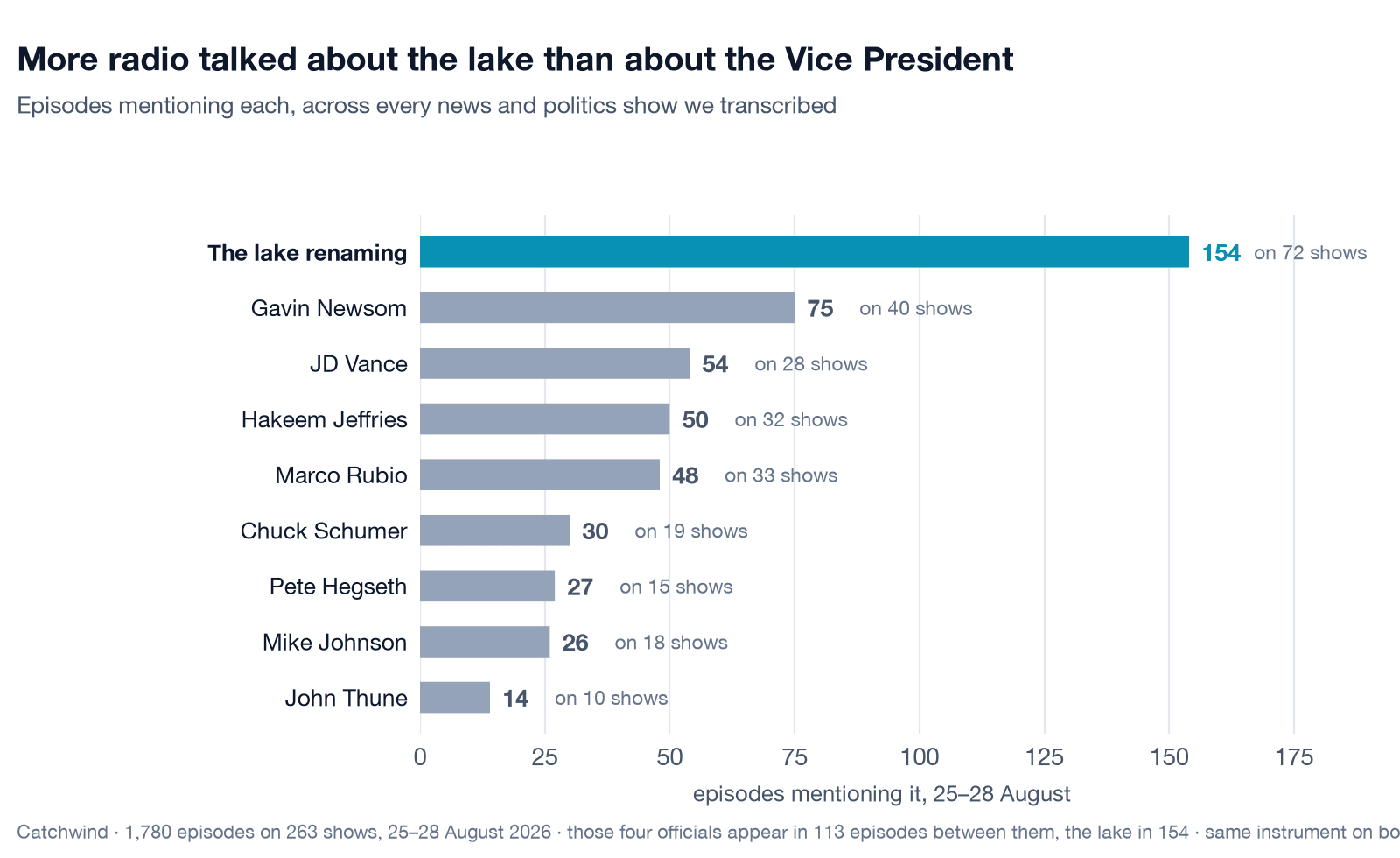
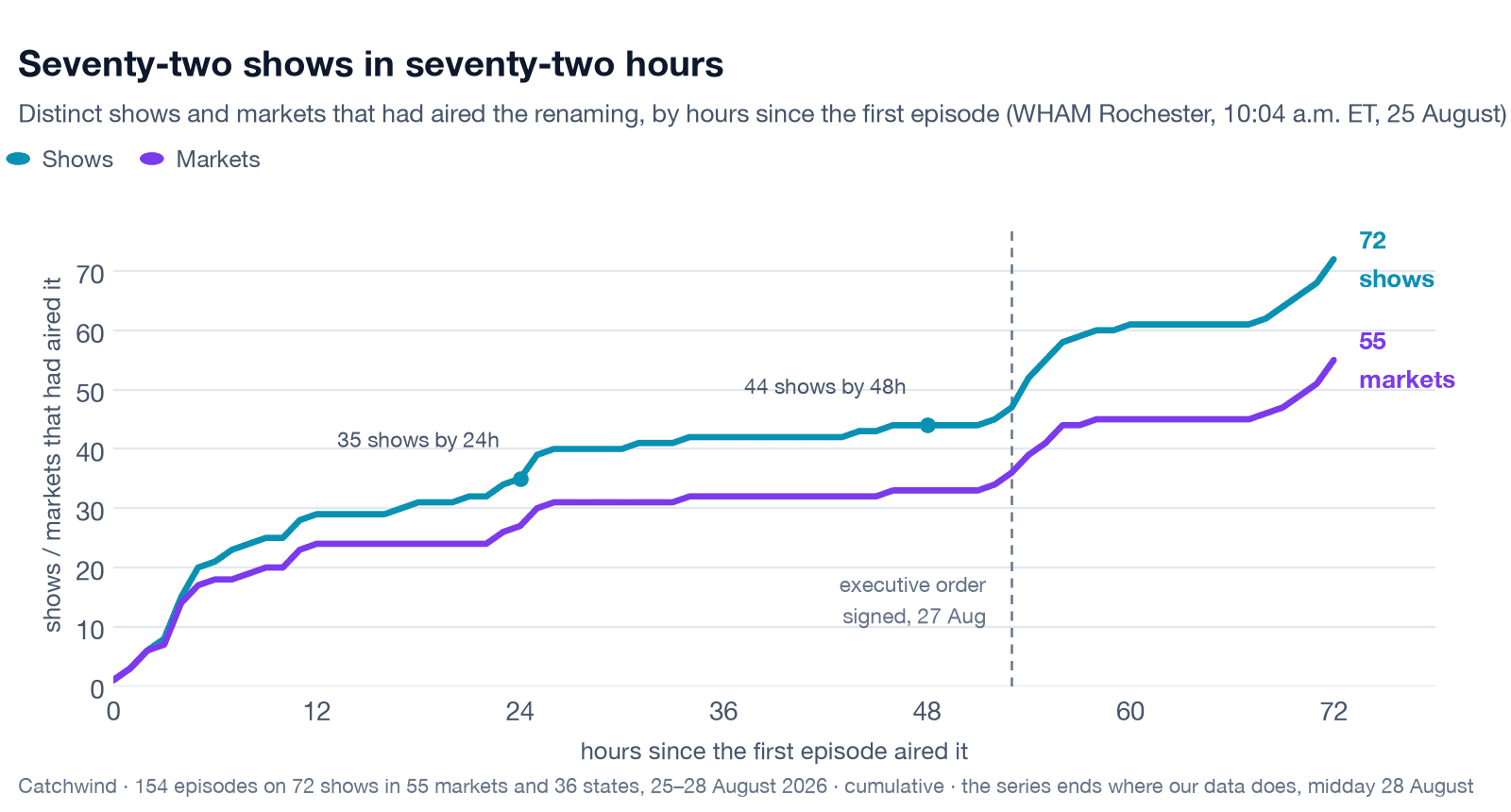
On 25 August the president posted that he was thinking about renaming Lake Ontario. Within 72 hours it had been aired on 72 shows in 55 markets and 36 states — more episodes than the Vice President, the Secretary of State, the House Speaker and the Senate Majority Leader put together. We read all 155 broadcasts. Six shows came out in favor, and all six were on the right.
Catchwind downloads and transcribes every episode of several hundred news and politics programs every day — NPR affiliates, local talk radio across 142 markets, political podcasts and the national shows — and then searches the transcripts for the people and subjects we track. That archive is now 93,501 transcribed episodes and 47,696 hours of audio. This is what three days of it looked like.
A lake outdrew the government
At 10:04 a.m. Eastern on 25 August, Trump posted that the United States was "giving serious consideration" to renaming Lake Ontario to Lake America, "in that we don't expect to be doing much business with Ontario any longer" — a shot in an escalating trade fight, hours after Ontario Premier Doug Ford called him a loser on camera. On 27 August he signed an executive order doing it.
Over the four days from the 25th we transcribed 1,780 episodes across 263 shows. The lake is in 154 of them. JD Vance is in 54. Marco Rubio 48. Speaker Mike Johnson 26. Senate Majority Leader John Thune 14. Those four men appear in 113 episodes between them — the lake beat all four combined, and did it from a standing start. A post with no policy in it, no constituency and no cost bought more airtime in three days than the Vice President, the Secretary of State, the Speaker of the House and the Senate Majority Leader managed between them.
Seventy-two shows in seventy-two hours
The first show in our database to air it was, fittingly, on the lake: Bob Lonsberry on WHAM in Rochester, who read it out at 10:04 a.m. and told his audience, "No, this is a local story, kids. You better pay attention." Then he made fun of it (10:13):
"I hate to come off like a rebel, okay, and I don't want you to call me a rhino, but around the house, when the shades are drawn, and we don't have any company there, and we've unplugged the smart speaker so we know no one is listening, we still call that body of water south of Louisiana the Gulf of Mexico."
Fifteen shows had it within four hours. Thirty-five within a day. Seventy-two within three, in 55 markets and 36 states — Wichita, Fargo, Memphis, Huntsville and Honolulu all carried a story about a lake none of their listeners can see or likely have visited.
Breadth is not engagement, so we separated the two by reading. Of the 72 shows, 61 had their own hosts, guests or callers say something about it; the other 11 carried it only as a network news read. Eighty-three percent of the episodes came from local stations, but national politics shows hit it hardest per episode: 18.5% of their output against 7.9%.
Six shows wanted it
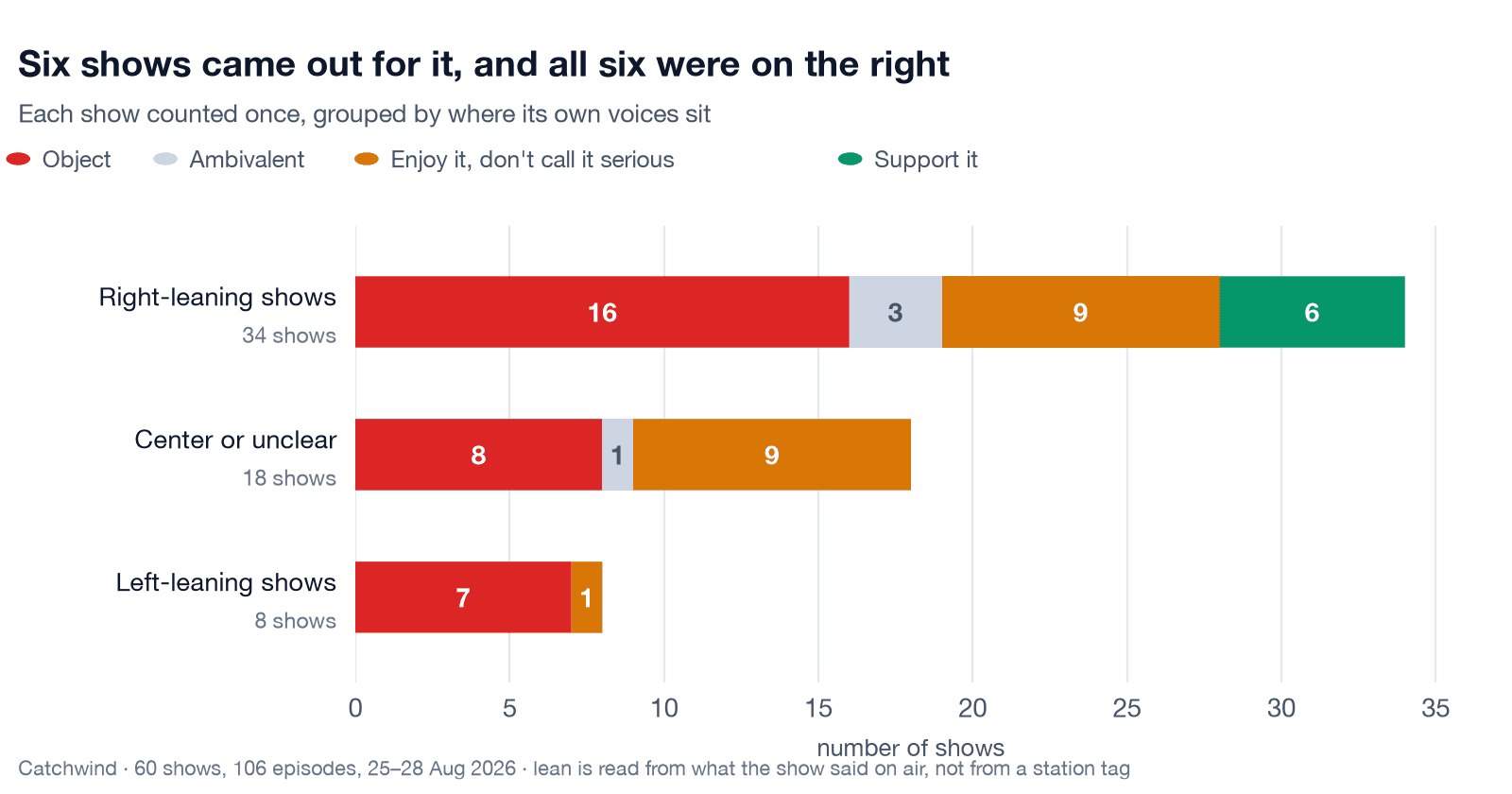
Sixty shows took an identifiable position. Thirty-one objected. Nineteen enjoyed it without claiming it was serious. Four were ambivalent. Six were in favor, and all six were right-leaning — no show we could identify as center or left endorsed it (shocking).
It seemed like even the right was a little befuddled. Erick Erickson, seconds after the wires moved, mid-way through handicapping the Senate map (15:19): "The president has signed an executive order to rename Lake Ontario to Lake America. I'm sure that is going to win Republicans the midterms. My goodness." A WGAN host in Portland, Maine, before turning on Governor Janet Mills for saying much the same thing (1:18, 2:40):
"This is indeed stupid... I was out for it with the Gulf of Mexico, too... Lake Ontario was not named because of Ontario Canada. Ontario Canada was named because of Lake Ontario."
It reached elected Republicans within two hours. WBEN in Buffalo had State Senate Minority Leader Rob Ortt on the line by 10:06: "Ontario was not necessarily named for the Canadian province, but goes back to Native American tribes and people who lived here and who named it that... I'm as patriotic as anybody. I don't think it does anything necessarily."
The six who wanted it wanted it plainly. O'Connor and Company on WMAL in Washington, ninety minutes in (1:21:23): "Change the name of Lake Ontario is a great idea. We're on board. In fact, maybe we'll do a cruise of Lake America next year."
Chris Plante, also on WMAL, made the case and bid it up — proposing Lake America Superior, Lake New York and the Gulf of Chihuahua (18:46): "Why do we call it Lake Ontario? We could just call it Lake America, because do we have to keep reminding you people that you're Canada? We're the big dog." Thirteen minutes later a caller from Falls Church described visiting "Oakville on Lake America" — the new name in ordinary use, unprompted, thirty hours after the post. But across his four episodes he endorsed it in two and played it as a gag in the other two, so his show lands in the amused column. Even the enthusiasm kept sliding into a bit.
The audiences were the split thing
Two shows put it to their listeners, and both got back something unusually divided.
Lars Larson, a syndicated Northwest conservative who had endorsed the renaming the previous day — "I do think we should probably do that. I don't think it's a bad idea" — read his own poll result on the 26th (1:24:06):
"Yesterday's question was this: should Donald Trump rename Lake Ontario as Lake America? 56% of you said yes, and 44% of you said no. That is one of the most divided responses that we've had in a long, long time."
Grace Curley, on the Howie Carr Radio Network out of Boston, went the other way (18:48):
"I'm not a fan. I'm not a fan. I think you got, like I said, you're president. You get one body of water. That's the Grace Curley rule... Everything else has to stay the same until you win another election."
Thirty seconds later she read the result: "No is in the lead with 39%. Yes and don't care what it's called, both have 31%." Seven in ten of a conservative Boston audience either opposed it or said they did not care.
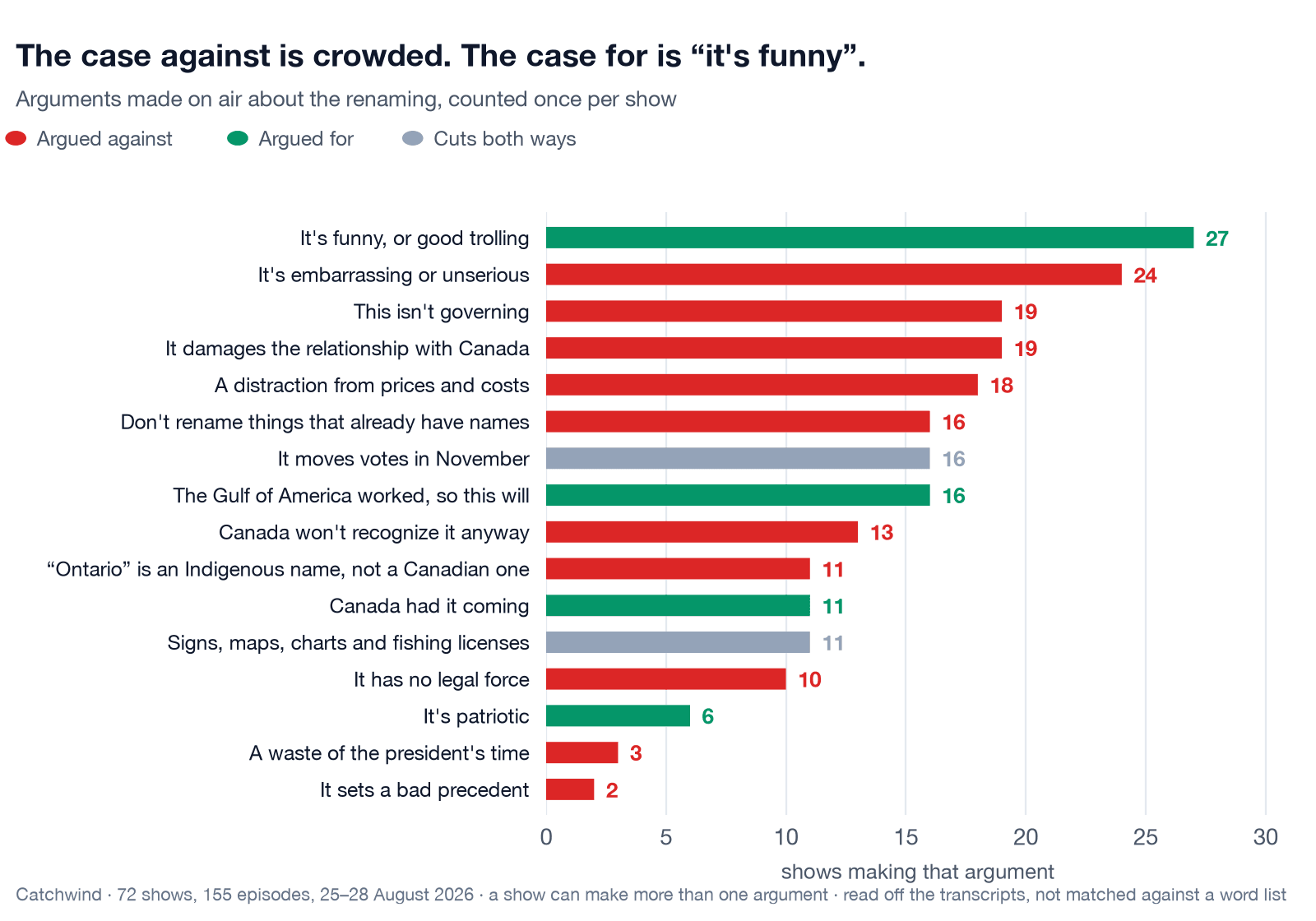
The most common thing said in favor was that it was funny (27 shows). The most common things said against were that it was embarrassing (24), that it wasn't governing (19), that it damaged the relationship with Canada (19), and that it was a distraction from prices (18). Patriotism was argued by six.
And the same two jokes kept arriving at stations with no syndication between them. Five shows, from Los Angeles to Chattanooga to Boston, landed on at least he didn't call it Lake Trump. Four more — in Omaha, Philadelphia, Detroit and Knoxville — worked out live on air that the mnemonic is ruined. Generations of American schoolchildren learned the Great Lakes as HOMES: Huron, Ontario, Michigan, Erie, Superior. Here is a host in Knoxville reaching the end of that thought (6:11): "Now it's Hames. That don't work. I don't think there's a word call Hames."
Three things worth taking
Symbolism is the most efficient earned media on the dial, and it is not free. Seventy-two shows in 72 hours cost one social post — and 58% of those episodes carried the tariff fight too, which is the defense the coalition's own people made: a Breitbart White House reporter told WELI in New Haven that "even if this isn't about Lake Ontario, it's about trade with Canada. By doing this, he draws so much attention to the underlying issue." Whether that trade is worth making is a judgment; that it is a trade is measurable.
The pushback comes from inside, and it comes fast. If you are watching left-leaning outlets for the reaction to your own symbolic move, you are watching the wrong dial. Most objections that mattered here — the etymology, the midterms, the price of gas — were raised by someone who votes with you.
Useful local data points. The two shows that actually polled got 56–44 and a 39% plurality against.
Methodology
Every transcribed episode published between 24 and 28 August 2026 whose transcript matches "Lake Ontario" or "Lake America": 155 episodes on 72 shows in 55 markets and 36 states. The comparison names are matched the same way, over the same 1,780 episodes on 263 shows — a name in the stored transcript, on both sides. 28 August is a part-day; the story was still running when we published.
All 155 were read and labeled — voice, stance, the arguments made, quotes — by a model reading the transcript, not by matching words against a list. A second labeler then re-read 40 of them blind, without seeing the first pass. The two agreed on the objects-or-not call 40 times out of 40, on supports-or-not 39 of 40, on the five-way stance 92%, on the show's political lean 98%, and on who was speaking — anchor, host, guest, caller, wire — 75%, which is the weakest number here. "Objects" means a case was argued against the renaming by the show's own voices, not that a negative word appeared. Where a show's episodes disagreed, the show is counted at the position it took most often, with ties broken toward the more critical label — a rule that can only shrink the supporter count, never inflate it. A show's political lean is read from what it said on air, because the station-level leaning tag in our catalog is a default for straight news, not a rating.
Three limits. Coverage is not opinion: 31 shows objecting is 31 shows broadcasting an objection, not a measure of what anyone thinks — and the two listener polls quoted here are self-selected call-in polls, not surveys. Our corpus is not balanced by ideology: 92% of the episodes in this window are local news, and we carry far more conservative talk than progressive talk, so "no left-leaning show supported it" rests on eight left-leaning shows and should not be read as a national fact. The safer comparison is the one inside the right-leaning panel, where 34 shows split 16 against and 6 for. Third, syndicated programs carried inside another show's feed — the Grace Curley Show inside the Howie Carr Radio Network here — are counted under the feed that carried them.
Catchwind is a political news intelligence platform built on deep local news audio — 300+ stations across 142 markets, transcribed every day. If you want this breakdown for your own state, market or issue, get in touch.